

Research
Digital SEO Land is now EvenSurge.

If a buyer can ask ChatGPT or Claude which software to pick, why would they ever visit a vendor’s website again? Our SaaS clients ask us some version of this question every month.
In November 2026, Kevin Indig gave us one of the clearest answers so far. In his Growth Memo piece How software buyers use AI, he analyzed a Wynter survey of 200 software buyers. They shared the actual prompts and follow-up questions they sent to AI while choosing a tool, and what they did after the chat ended. Kevin is open that the answers are self-reported and come from a SaaS-only group, but the patterns are hard to ignore.
We took his findings and set them next to the largest B2B buyer studies of 2026, from G2, Forrester and 6sense. Here is what the full picture tells us about how buyers deal with SaaS and software vendors once AI has had its say.
The buyers in Kevin’s study did not use AI once and stop. They used it to find vendors, test them and then check their findings elsewhere. Most of them (67.5%) used more than one AI tool, with Claude at 71% and ChatGPT at 62.5% the most common.
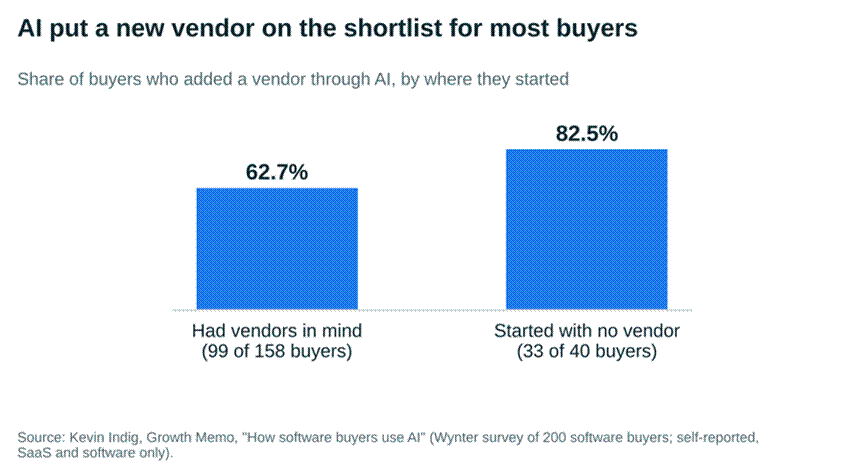
Most buyers came in with a plan. 79% already had at least one vendor in mind. Yet 62.7% of them added another vendor because of AI. For the 40 buyers who started with no vendor at all, AI put a vendor on the shortlist for 33 of them.
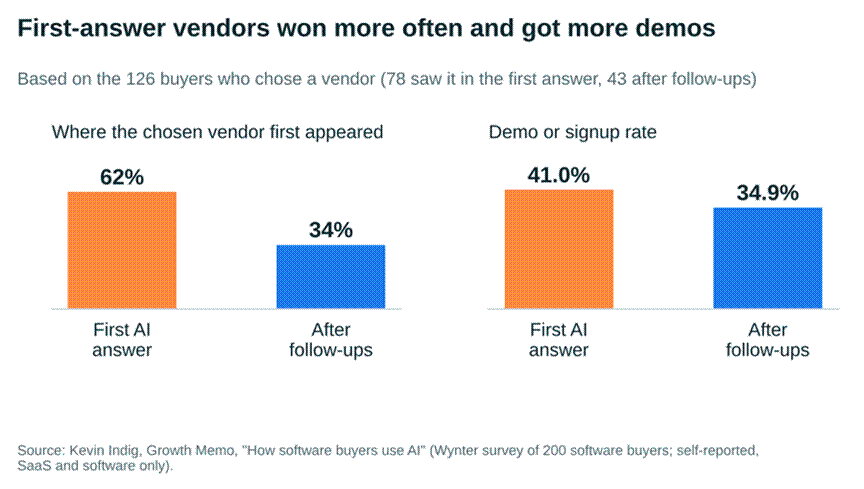
Of the 126 buyers who chose a vendor, 62% said that vendor showed up in the very first AI answer. Those buyers also booked a demo or signed up more often: 41.0%, against 34.9% when the vendor only appeared after follow-ups.
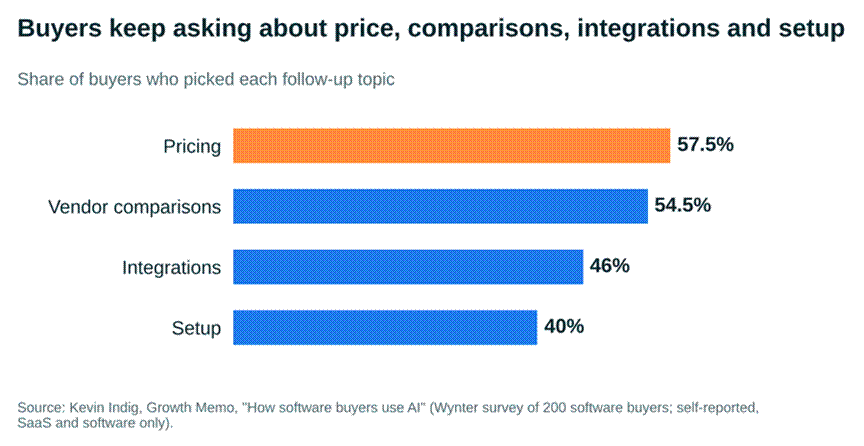
Even when the winner was in the first answer, 75 of those 78 buyers still asked follow-up questions. 41.5% sent 3 to 5 follow-ups and about a third sent 6 or more. The top topics were pricing (57.5%), vendor comparisons (54.5%), integrations (46%) and setup (40%). Buyers also used AI to cut vendors, for example by asking it to drop any tool without a Marketo integration.
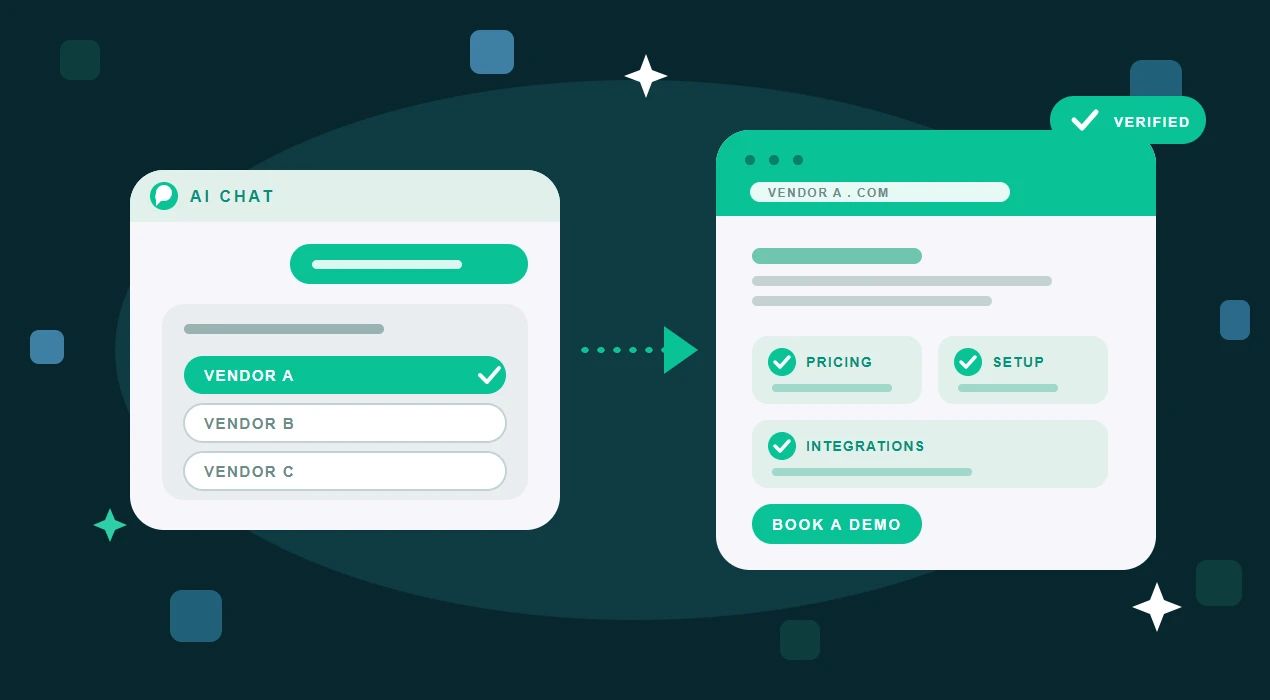
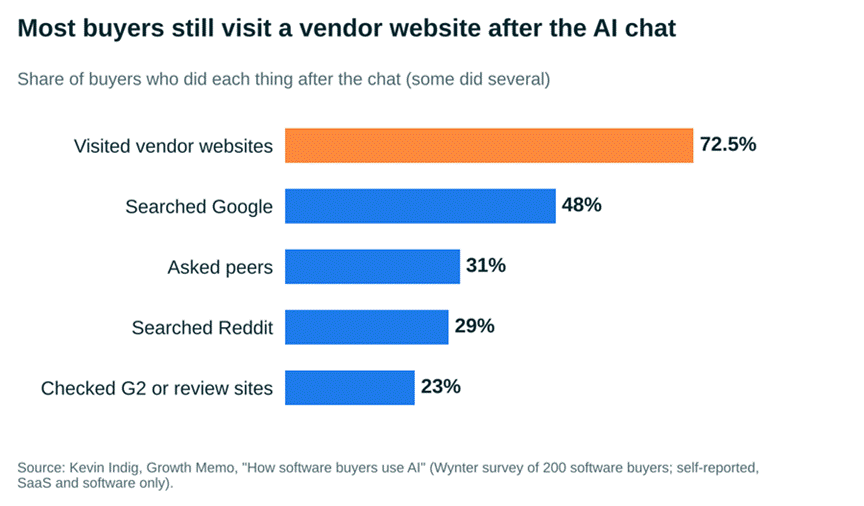
This is the headline. 72.5% of buyers visited vendor websites after their AI chat. 48% searched Google, 31% asked peers, 29% searched Reddit and 23% checked G2 or other review sites. AI starts the research, but the vendor’s own site is still where most buyers go to confirm it.
Kevin’s study is small and focused. So we checked whether the same patterns show up in much bigger buyer surveys. They do, and they add three things his data could not show.
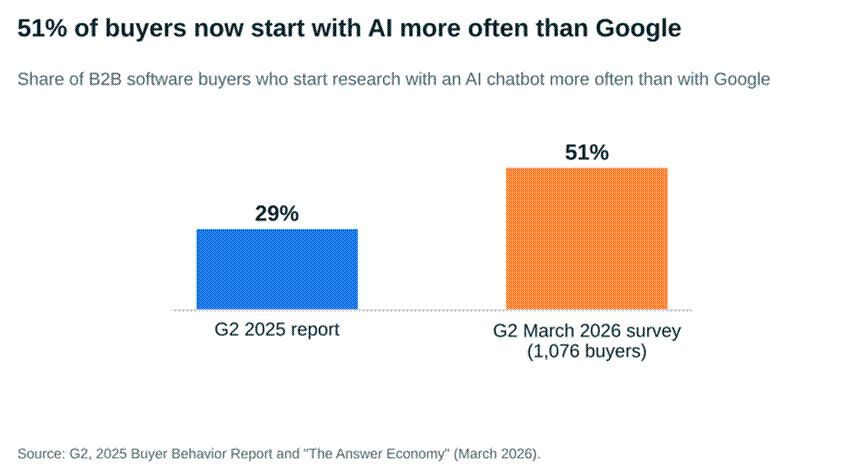
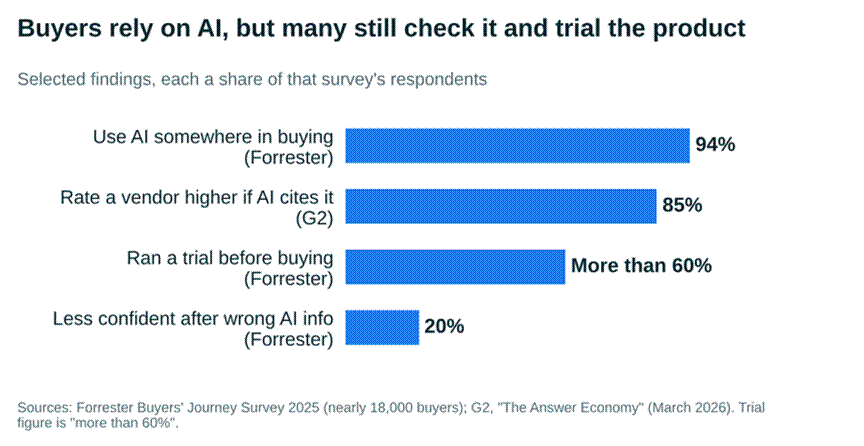
In G2’s March 2026 survey of 1,076 B2B software buyers, 51% said they start software research with an AI chatbot more often than with Google. In G2’s 2025 report, that number was 29%. Forrester’s survey of nearly 18,000 business buyers found 94% now use AI somewhere in their buying process.
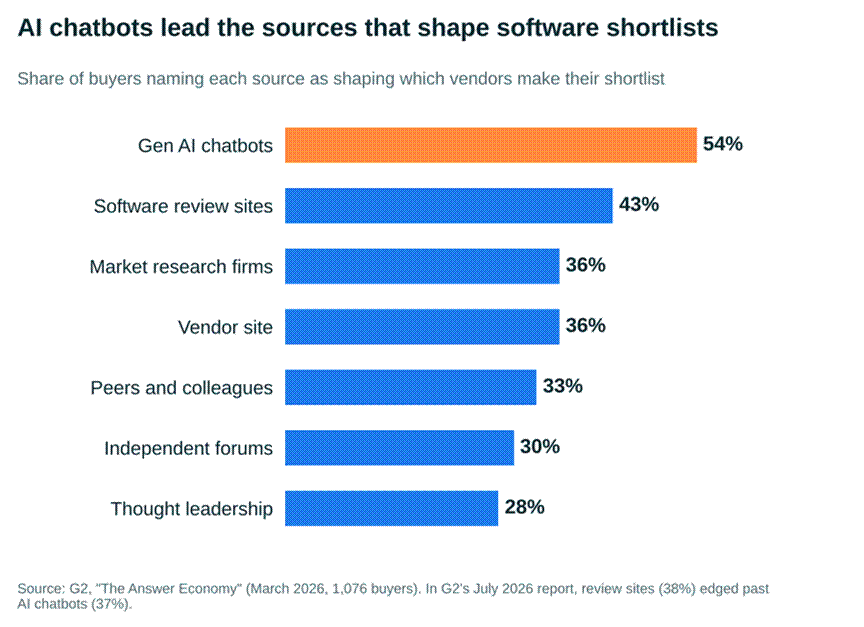
G2 found that 85% of buyers think more highly of a vendor when AI cites it in an answer. In the same report, AI chatbots were the top source shaping shortlists (54%), ahead of review sites (43%) and vendor sites (36%). By July, G2’s larger buyer behavior study showed review sites (38%) edging past AI chatbots (37%). Our reading: AI and reviews are not rivals. Buyers use one to find vendors and the other to trust them.
6sense’s 2026 Global B2B Buyer Experience Report found 92% of winning vendors were on the buyer’s first shortlist. Buyers spend about 60% of a 10.3-month buying cycle choosing vendors before they contact a seller. If AI is now shaping that first list, the window to be seen is earlier than ever.
Forrester found 20% of buyers felt less confident after AI gave them unreliable or wrong information. More than 60% ran a trial before buying. This is why the vendor website visit in Kevin’s data matters so much: it is where buyers check whether AI got it right.
The questions buyers ask AI are a map of what they come to your site to confirm. When a page cannot answer them, someone else will.
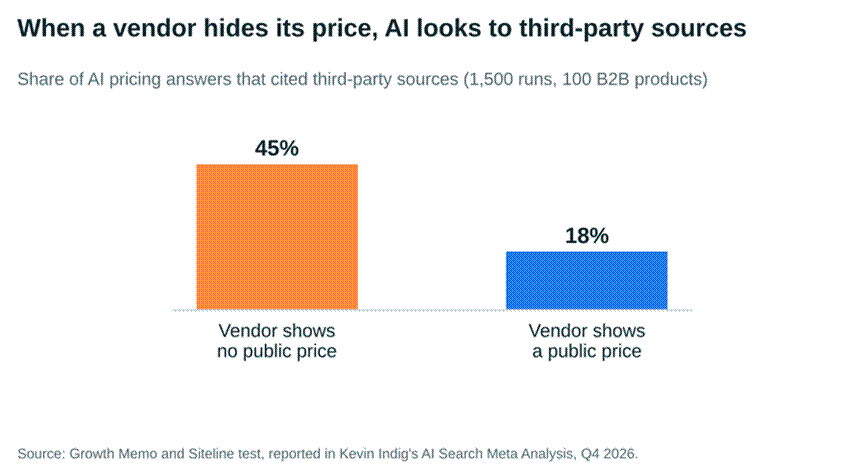
Pricing was the top follow-up topic in Kevin’s study. A separate test he ran with Siteline, covered in his Q4 2026 meta analysis, shows what happens when it is missing. Across 1,500 AI runs on 100 B2B products, AI pulled pricing from third-party sites in 45% of runs when the vendor hid its price, against 18% when a public price existed. Hide your price, and a review site or a competitor’s blog tells the buyer what it thinks you charge.
Integrations came up in 46% of chats and setup in 40%. Buyers want a page that plainly lists what you connect with and how long it takes to go live, not a vague promise.
Over half of buyers asked AI to compare vendors. A fair comparison page on your own site gives them, and the AI, your side of that story.
A good website is only half the job. The other half happens before the buyer ever lands on it.
The first AI answer is where most software deals now begin. Our GEO (Generative Engine Optimization) service is built to put your product there, and to make sure buyers find what they need when they click through.
Hiring and training an in-house GEO team takes months. With EvenSurge, you get that skill from day one, for far less than the cost of one senior hire.
Want to see where your SaaS brand stands in AI answers today? Talk to our GEO team.
AI has not cut software vendors out of the buying journey. It has moved them. Buyers now meet your brand first inside a chat window, test it with follow-up questions, and then come to your website to check that the answer was right.
That means two jobs, not one. Be in the first answer, and be ready with clear pricing, integrations and proof when the buyer clicks through. The SaaS brands that do both will win deals before their competitors even know a buyer was looking.