

AI
Digital SEO Land is now EvenSurge.

An AI marketing strategy is a plan that determines which parts of the marketing AI will perform, which parts people will do, and what business outcome is expected from the process.
The majority of businesses have AI solutions, but not the AI marketing plan. Jasper’s State of AI in Marketing 2026 reveals 91% of marketers currently utilize AI, with 41% being able to demonstrate its ROI.
New to the topic? Know about what is AI marketing. Here is the six-step framework based on the touchpoints of a business’s online presence.
AI marketing strategy is the division of labor. AI does the production: drafting, variations, repurposing, reporting and data cleansing.
Humans still make the decisions: positioning, offerings, the first message to a real prospect and all the relationship building afterwards.
As Lilach Bullock says it better than anyone I have read so far and this whole post is about that.
This is vital to your image online, because everyone can afford production now. If all of your competitors produce ten times more, then it’s not about the amount, but relevance and trust.
This is a recipe for disaster and it’s clear in Q1 2026 Pulse from Sprout Social. 56% of social media users often see poor quality AI generated content and unlabeled AI generated content is the number one thing they want brands to stop doing.
More production without a strategy means that you will be ignored. Strategy is a low cost production method that targets the desired outcome.
These numbers show how far AI in marketing strategy planning has come from the experimental stage to budget line.
AI is now responsible for 24.2% of marketing activities among US companies compared to 13.1% in 2024. The top marketers forecast 55.9% in three years. (The CMO Survey, spring 2026)
30% of CMOs say they are prepared to scale AI marketing, while 15.3% allocate budget to it. (Gartner 2026 CMO Spend Survey)
So far, that is the number of businesses that are already working to be found in AI search results. (The CMO Survey)
The budget and the usage of AI in marketing is clear. But strategy is not yet.
Below is the AI marketing framework which we will discuss further throughout the post. It is based on the five touchpoints when a customer meets your brand: search, AI responses, social, e-mail and messaging, and ads. Each step includes an action that can be taken now.
Not “use more AI.” It’s an activity but not an objective. A real objective is to have 30 qualified leads a month, lower cost-per-lead by 20%, or improve the position on 10 commercial keywords.
Madgicx offers you a fill-in line challenge: “we will use [AI application] to improve [number] by [amount] in [period].” If you cannot do that, then there is no objective.
Choose one number, not five. Single KPI is easier to baseline, easier to test and easier to prove in front of the management.
Now take action: write down the line above and place it somewhere for everyone on your team to see.
It’s a map of the current digital footprint. List five most popular locations where your client gets information prior to buying from you: AI Answers (ChatGPT, Gemini, AI Overviews), social media, email, and messaging, and paid advertising.
Describe briefly what you have already and one measure of its effectiveness.
| Channel | What we have | Current number | Target number |
|---|---|---|---|
| Google search | Pages, blog posts | Organic traffic or leads | Your target |
| AI answers | Pages that respond to consumer questions | Citations or brand mentions | Your target |
| Social | Profiles, posts | Engagement rate | Your target |
| Email and messaging | List size, flows | Open rate | Your target |
| Paid ads | Monthly spend | Cost per lead | Your target |
The map shows you where you are weak and where you should go for a first impression with AI. Typically, small businesses find that they don’t exist in the AI responses.
The 41.5% in the CMO Survey indicates that your rivals are already considering it. Also, Sprout Social notes that AI search leverages information from social media posts and forums, so you need to be visible beyond your website as well.
To Do Now: Fill in the table.
Use the production vs. judgement separation for each channel.
| Channel | AI handles | People handle |
|---|---|---|
| SEO content | Research, briefs, first drafts | Expertise, final editing, what to publish |
| AI search visibility | Finding what questions people ask | The unique answers from your business |
| Social | Captions, variants, scheduling | The point of view |
| Subject lines, sending time, segments | The offer | |
| Paid ads | Bidding, creative variants | Budget and landing page |
This creates the human and AI workflow table that Madgicx uses for their paid media automation in all channels.
Now, defend your brand’s voice. First, make a one-page document outlining your brand’s voice before creating any creative elements.
According to Lilach Bullock’s guide, you need five specific examples of your own writing style, three phrases that you would never use, and one paragraph written by yourself. Give it to tools as an input for each tool.
To-do Now: Label each task on your map as either human or AI.
Your tracking is clean. Your analytics, conversion events and UTM naming are clean and consistent.
Automation makes what you already have better or worse, depending on the quality. “Garbage in – garbage out.” Braze and Taboola have warned about this, so let’s move quickly. Check three items:
To-do Now: Write down this month’s baseline for your Step 1 number.
Tools come last since choosing a tool before a goal is making an assumption. You’ve known the output, the channel, the action, and the data. The four factors mentioned above determine your needs.
There are two kinds of AI marketing tools. One contains AI that you already bought, incorporated within platforms such as Google, Meta ad automation, sending time and subject line features in your email marketing tool, and your CMS.
Another kind is standalone tools. Madgicx makes the same distinction between platform-native and third-party tools. Each workflow from the first kind requires a general AI assistant to complement the tools that you have.
Now cap it. Maximum three tools for year one, each tool must have its named owner and 90 days of review on their usage before the renewal period.
Action step: List down the AI features already included in the paid tools.
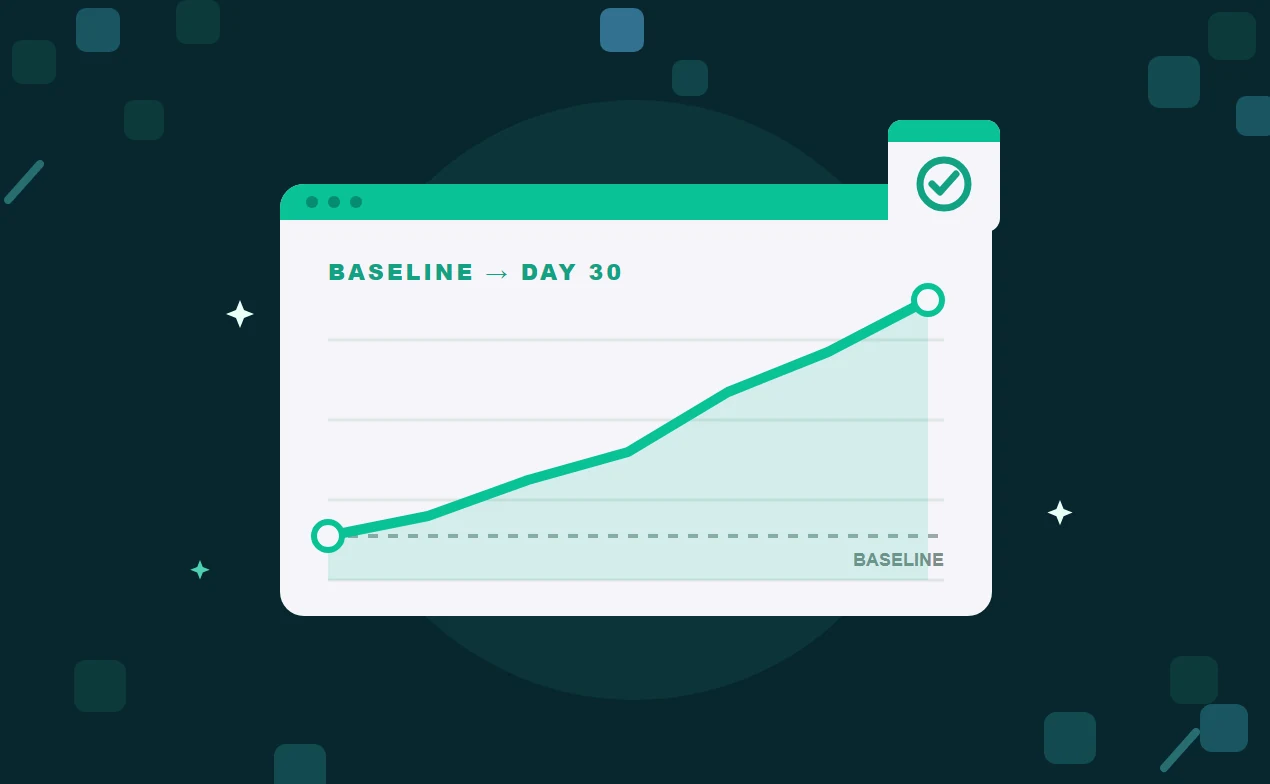
Launch one test for 30 days on the most vulnerable channel found in step 2. Measure it against your baseline from step 4. According to Sprout Social, tests should always be run for at least 30 days. Less time means you only measure noise.
Tests could look like this:
For example, Madgicx’s goal of 15% lower cost per acquisition after 30 days on 20% budget spend looks like a reasonable benchmark for this product.
After that you need to plan out a 90-day cycle: the first month for testing, the second for optimization and validation. The third month is for scaling and the next test.
Do this today: Select your test and set the day you will measure it.
The majority of AI marketing strategy examples will be related to those channels where you’re currently being found. Here are five of them along with the numbers where possible.
AI-driven content creation programs also rank if a human edits and brings their own expertise to them. AI does the research, writing briefs and the first draft.
You bring the expertise, examples, and opinion that an algorithm cannot think of. Drafts in bulk that are not edited will produce the opposite effect. The value is in the edit, not the draft.
ChatGPT and Google AI Overviews use citations for sources that provide answers to a particular question. Generative engine optimization is the process of becoming one of those sources.
Answer the exact questions your customers ask, structure your pages to be quoted and cited in the forums that these tools use.
OneRoof achieved a 23% increase in click-to-open rate and 218% increase in clicks to listings by using localized, AI-scheduled emails (Braze case study). It is because of the accuracy of the customer data, hence Step 4 before automation.
AI recommendations of dishes from Pazza Pasta via WhatsApp channel showed 6 times better conversion rate than via email channel (Braze case study). The task of AI was simple, to recommend the right dish. The offer was made at the human level.
In the pilot project by Madgicx, AI was used for bidding and creative testing of 20% of media budget and it decreased cost per acquisition by 15% in just 30 days. The rest of the budget stayed unchanged. Hence, the test was clean and the risk was low.
None of the above results were achieved due to increased use of AI. It was achieved with the help of AI driven marketing strategy that gave the tool one narrow job and a goal to beat.
Measure your number of interest before AI, not the amount of output produced by AI.
| Channel | Number to track | What “working” looks like |
|---|---|---|
| Search | Rankings and organic leads | Higher rankings and more organic leads than baseline |
| AI answers | Citations or brand mentions in AI tool for your key questions | Your brand shows up in more key questions each month |
| Social | Engagement rate and inbound messages, not followers | Both increase compared to baseline |
| Revenue or leads per send | Higher revenue or leads per send than before AI | |
| Paid | Cost per lead or ROAS | Lower cost per lead or higher ROAS at the same budget |
| Time saved | Hours per week | More hours for judgement, keeping quality steady |
Here are two principles that sit under the table:
This was proven by Jasper’s 2026 data. Teams who changed the way they measure are the ones with 2 to 3x ROI.
Gartner statistics show where you stand: 15.3% budget allocated for the AI but only 30% CMO’s comfortable with scalability. It is about skill, not technology.
You have three options.
It works for one channel and a limited database. As an AI marketing strategy for small business, this can be an option, if someone does a pilot and defines a baseline.
You pay salaries per skill and AI skills change every few months. Hiring one person does not cover search, AI answers, content, email and paid.
AI marketing agencies who use AI for SEO, AI search, content and links for several customers will make six steps work without hiring for each of them.
In case of a small business or a larger business who lacks such staff, partnering with an agency would be the fastest way to implement the above structure.
At EvenSurge, we ensure the process is transparent, the approach is white-hat, and the reporting is tied to your baseline.
Take the following six steps in sequence: define one target and number, map your visibility, distribute the workload between AI and people, clean up the data, choose the tools at the very last, and run the 30-day pilot.
Taking tools as the starting point is the most typical blunder. Define the goal first and tools will come after that.
Start with fixing your existing problem and not with the tool. Complete step 2 channel map, find your weakest channel, conduct one 30 days pilot. The experiment on a smaller scale with clear numbers is more valuable than yet another brainstorming session.
Measure your baseline first. Conduct the pilot project with a sample of your workload and compare it with the older baseline after 30 days.
Jasper states that only 41% of marketers can demonstrate ROI from AI, and those who switched their metric criteria have 2 to 3 times more returns. Provide Leadership with a number, not with an assurance.
AI for the production tasks, people for the decisions. Let it do the research, summaries and content creation. The offer, positioning and publishing will be your calls. AI can challenge you, but it will never know your customers, margins and risks.
Yes, unedited AI content at scale will. According to Sprout’s Q1 2026 pulse, 56% of social media users frequently see poor quality AI content. The drafts that are created by AI and edited by humans do just fine.
Always label AI content when necessary, since unlabeled AI content is what people want brands to stop using.
Typically, a general AI assistant and all the AI that is already in the paid-for tools that a small business uses. Limit additional AI tools to three in year one, assign ownership to each of them and review usage every 90 days before renewing them.
The goals and the audience remain the same. The choice is made regarding which aspects of implementation belong to a machine and which should stay manual. A regular strategy leaves this to routine. In an AI marketing plan, it is written up.
A strong online presence in 2026 means being found in search, in AI answers, and on all channels used by clients, as well as being trustworthy when they reach there. AI streamlines the process. Strategy defines the process.