

Link Building
Digital SEO Land is now EvenSurge.
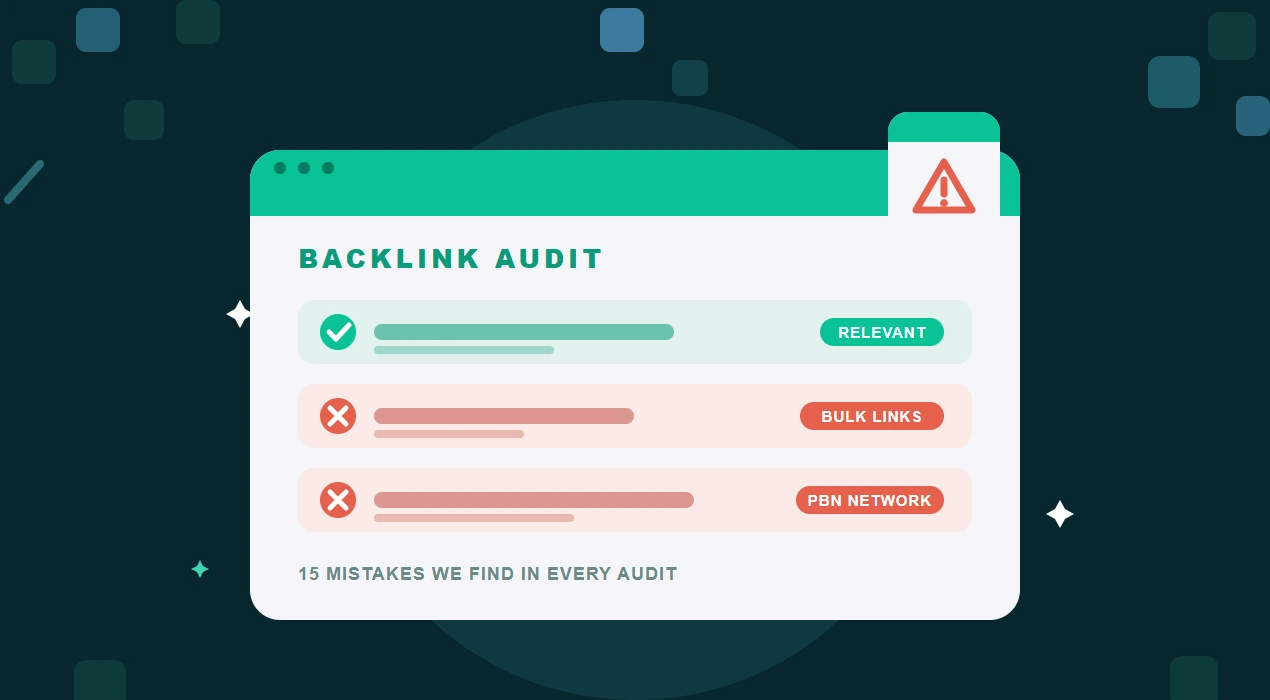

Link building errors are the mistakes you make in building links or earning links that can hurt your website’s performance, activate Google’s spam filters, exhaust your budget and even hurt your search ranking.
They include focusing on quantity over quality links, over-optimizing anchor text, buying bad quality backlinks, and accidentally removing quality backlinks.
These patterns just keep coming on the surface when we audit the true backlink profile of real sites on our client’s websites.
Instead of making mistakes, we are now talking about consistent patterns that have a very subtle effect on the growth of a site. And, everything after these is affected by three modern fixes.
The first is that the SpamBrain from Google is not working in Penguin waves but works continuously.
The second one is the fact that the disavow tool is an edge case and not a good practice.
The third one is the fact that it is not about the number of links, but rather the quality of the links and mentions of the brand.
As you read, use those as your guide.
Most guidance on link building considers bad links as some mess to be addressed at a later stage. This is not how things should be considered. The best way to stay away from bad links is to not get them in the first place.
Cleanup is expensive, time consuming and may not be necessary. Prevention is inexpensive and is permanent.
The old model to deal with spam was simple: build links, wait for the Penguin ‘refresh’, and get hit or dodge. That era is long gone by now.
By means of SpamBrain that was updated in the 2025 August spam update by Google, machine learning occurs system-wide by interpreting patterns of relations among link networks, domains, topics’ clusterings, anchor texts and histories of each relevant domain. The enforcement is constant around the clock. No individual backlink worries.
And here is the disclaimer by Google. Once their systems discount the presence of spammy links, they take away any advantage that those links would have provided you in your rankings.
Hence, for getting back on track, link cleaning cannot work in your favor; it will nullify the value that has been given already in the form of a discount. Prevention is a better approach than cleaning and disavow is far from being reset.
Each of the points below has three sections: What it is, why it hurts, and how to resolve it. This list is about link building mistakes that are done frequently, from basic ones to those diagnostic and strategy-oriented that may baffle even experts.
The myth of quantity will just not go away. Yes, there was one study that showed that 96% of pages ranking in the top 10 pages had more than 1,000 links pointing at them, but correlation is not a recipe.
Other studies have shown pages ranking in the top three with hard keywords having just 12 backlinks. Quality always trumps quantity when it comes to links.
The solution: Stop counting backlinks and start assessing their quality. Get relevant editorial backlinks from websites that actually have traffic and an audience that is also relevant to your business. Forget about trying to get a lot of links, and focus on getting quality links.
A link from a cooking blog to a cybersecurity SaaS is a confusing signal for Google. Relevant linking is no longer a nice-to-have. The search engines assess the topical relevance of both the linking page and your page.
The solution: Concentrate on acquiring backlinks from sites that are connected to your industry or near to your niche. Evaluate the relevance of the linking website by looking at its topic as well as the particular page where your link is placed.
Sometimes, one link coming from a smaller and relevant website will be worth much more than multiple links coming from unrelated but high-traffic websites.
Anchor text proportions have now become quite stringent. The former standard was that about 30% to 50% of the anchors be exact match.
Now it is believed that any level of exactly matching anchors in excess of 10% is engineered and should be re-evaluated. Having a large proportion of your links use the exact match of the keyword that you need to rank for is a clear sign of manipulation.
The solution: Do not use the same exact matched key phrases in the anchor texts, use different styles of the anchors. This can include branded, partial match phrases, naked urls and unbranded anchors.
Vary the anchor text depending on the specific link instead of using the specific keyword for each link.
Linked to anchor text, but more broad. If a profile consists of just dofollow links, it looks like it’s being done for manipulation, as the actual link profile is cluttered.
Also, real sites receive nofollow links, mentions, and citations as well as dofollow ones. When you’re just going for dofollow links, your profile might look fake.
The solution: Build a diverse backlink profile, rather than only targeting dofollow links. Make use of a combination of dofollow and nofollow links, mentions, citations, directories, and links from sites of varying authority.
Focus on relevance and quality, instead of trying to control the type of each backlink.
The value of a link is determined by the page being linked to. There are plenty of valuable backlinks that link to pages that have no search demand for their keyword phrases or that link to irrelevant pages. All this authority goes to waste.
The solution: Create links to pages in consideration of the demand for the search, the purpose of the search, and business value. Link to pages that are optimized well, provide real value, and have the ability to rank and convert.
Don’t create quality links to poor-quality, untrustworthy or unhelpful pages simply because it’s easier to do so.
Sequencing errors are common and can be very expensive. Going straight to link building without optimizing on-page SEO and matching search intent is one of the biggest strategic mistakes that we usually see.
Links cannot fix a page that doesn’t give the user what they are looking for.
The solution: Build a content foundation first before moving on to link acquisition. The page should match the search intent and provide an actual answer that’s better than competing pages.
After ensuring that the content has the potential to earn links, move forward with link building to strengthen its visibility and authority.
Guest posting is not dead yet; the intentions matter. Google’s John Mueller said that creating guest posts “primarily for links” is a violation of guidelines. The thing is that word “primarily.”
The well-researched article that will be published on a relevant website with just one contextual link is a good article from an editorial point of view. The article written by a person with bad writing skills that includes three exact match keywords is not.
That matter has become especially relevant in the October 2025 update that aimed at punishing AI-generated guest posts “purely for paid links”.
The solution: Think about guest posting as an opportunity to create some unique and valuable content. Create thoroughly researched guest articles for relevant websites and ensure that all the links are natural and contextual.
The article itself should be valuable for the audience of the website while the backlink should be the second priority.
Even today, private blog networks and link networks are being offered as one of those “shortcuts.” They do not work.
The presence of multiple backlinks from websites that share the same IP address is one of the classic signs of a link network, and SpamBrain identifies precisely those kinds of relationship patterns across different domains.
Link schemes have not disappeared after Penguin. They have evolved, and the detection has done the same.
The solution: Do not use PBNs and artificial link networks at all, instead strive to get backlinks through outreach, quality content, digital PR, collaboration, and editorial coverage.
Use independent sites with their own audience rather than trying to manipulate search engines using interrelated domains.
There are always numerous cheap bulk link offers that come to everyone’s mailbox; and, of course, the Indian market is no exception – thousands of links for a couple of thousand rupees to be delivered tomorrow.
It is exactly here that the recycled links network, which is already penalized by Google, emerges from. Money is wasted on links that are absolutely worthless and even hurt rankings.
The solution: Do not buy any cheap bulk link packages that guarantee hundreds or thousands of backlinks. Only seek a few credible backlinks from relevant sites with a real audience and good content.
Rather than the quantity of links that can be gained, concentrate on the quality, relevance, and credibility of each placement.
An email starting with “Dear webmaster” and being pasted is instantly sent to trash. Non-personalized and non-targeted outreach emails are worthless today and are silently wasting money through emails that recipients are not going to open anyway.
Mass blasts can easily be recognized by editors and website owners.
The solution: Make your outreach email personalized for each targeted website, editor, and piece of content. Let them know why this content could be useful to them. Don’t send thousands of emails; target just a few prospects with good research.
It seems strange, but building only high domain-authority links can be seen as unnatural. Organic profiles are not made up of solely high-authority sites. Real brands have links from various sources. An all-high-DA profile can read as curated rather than earned.
The solution: Try to build a balanced backlink profile instead of focusing only on high-DA websites. The key factors to focus on are relevance, editorial quality, and real audience value.
At the same time allow links from both established high-authority sites and smaller, credible websites in your niche.
That’s the typical mistake almost all listicles make. Disavow tool is not a maintenance procedure. As Mueller explicitly pointed out, most spammy, paid, placed or swapped links are usually ignored by Google, so the usage of disavow tool is rather rare.
Moreover, he added that if an SEO tool highlights “toxic links,” it means that it’s a red flag and you have to keep disavowing links all the time. Bing also got rid of its disavow tool claiming that their algorithm can decide which links to count.
The solution: Disavow should be seen as the last option in your backlink maintenance strategy. You shouldn’t disavow links just because SEO tools call your links “toxic.”
First, you need to determine whether the link causes you any trouble or it is being ignored by search engines and only then consider disavowing when there is clear evidence that it is necessary.
Glenn Gabe once undid a disavow file which had over 15,000 backlinks, after which the site’s ranking went through the roof, because those “low quality links” were actually contributing towards ranking.
For targeted spam links, domain-level disavow that uses the domain prefix is better and more straightforward than listing out individual URLs.
The solution: Use disavow only where there is a risk of harmful links. Be careful about the links you are disavowing, try to eliminate harmful links when possible, and do not use disavow for links only based on spam scores provided by third parties. If disavow is needed, use domain-level entries for concentrated spam.
Manual action is possible, and more than 60% of them are related to links. The recovery from an unnatural link penalty on the whole site takes three to six months, while partial actions take four to eight weeks of hard work.
Though the full restoration is not possible in any case, since artificial authority is lost.
The solution: You need to find out what caused a drop in ranking/traffic before doing anything with your backlinks.
Look into Google Search Console for manual action, compare the time when drop appeared with algorithm update dates and see changes in ranking, traffic, content, competitors. Don’t disavow or remove content before making sure that this drop happened because of your links.
AI search engines are moving from keyword-based to entity-based search. Brand mentions are becoming a separate metric while semantic relevance becomes more important than backlinks alone.
According to the survey, 73.2% of SEOs think that backlinks affect visibility on AI-driven search engines, but these backlinks will be given to sites which generate their own research or expert data.
The solution: Establish brand authority beyond mere backlinks. Get brand mentions, write original research and valuable data, and create content that can be cited by other sites and AI systems.
Make sure that your brand name and information about your business are consistent on trusted sites.
Evaluate your backlink profile at least once every three months. This will allow the evaluation process to pick up on problematic trends early on before they become worse.
That said, the audit is a monitor and not an indicator for disavowing links. For most quarters, the backlink profile is fine and it just needs to be evaluated, and there is absolutely no need for disavowing.
The real safeguard lies in prevention and constant monitoring, not an ongoing practice of disavowal. Look at the profile, know what is being added, and only take action when there is a reason that can be proved.
There is one thing in common with almost all the problems mentioned above, and there is one solution to it. Relevance, intention-relevant link targets, proper editorial placement, anchor diversity, and continuous monitoring will help you avoid most of the problems people find hard to solve after months of effort.
That is the whole point. These are preventive measures perceived as a cleaning process.
With a smart link building strategy, you can get links from relevant sites, direct them to appropriate target pages, diversify your anchors naturally, and skip networks and bulk buys altogether. Then you’ll have no use for disavowal at all.
This is how we build links: white hat, data-driven, and transparent. Your profile will remain clean not because it was cleaned but because it was built the right way.
There are three solutions that are especially important. SpamBrain analyzes your entire profile all the time, so the single-link approach will never work for you again.
Disavowal is a solution for emergencies only, not for maintenance, so do not get scared of toxic-link tools.
Lastly, relevance, target intent, and mentions are becoming more important than quantity, particularly since the AI-driven search favors citations.
Avoiding the link building mistakes described above, you get rid of virtually all dangers from their roots. Take care of doing everything right from the beginning, monitor everything thoroughly and let the relevance do the job Google already rewards.
Are you suspecting any of these problems happening in your profile? Ask us for a transparent, white-hat backlink audit. We will show you what works for you, what is missed and what is crucial without any scare stories and toxic-link drama.
Ready to build links in the right way? Try our link building services and let us map a plan around real relevance and measurable authority.