
AI
Digital SEO Land is now EvenSurge.
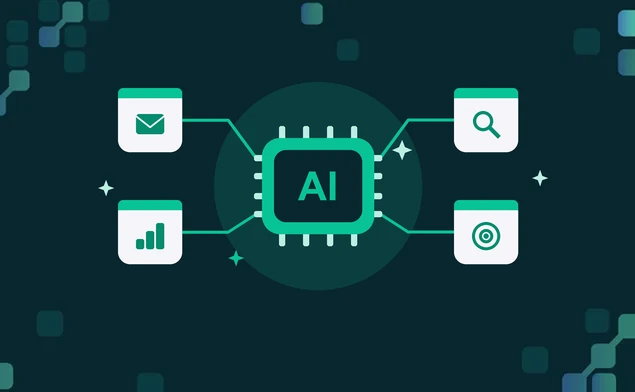

AI marketing is the application of artificial intelligence, including machine learning, generative AI, and AI agents, to perform marketing tasks: analyze customer data, predict customer behavior, create and design content, and launch campaigns with less human intervention.
It is marketing performed with the help of tools that learn from data rather than merely executing the predefined rules of a person.
The transition has been quite substantial. According to The CMO Survey (spring 2026), AI currently performs 24.2% of marketing tasks in US companies, compared to 13.1% in 2024.
This article covers what AI in marketing actually means, how it works, where it helps, where it breaks down, and how to start without wasting your budget.
Simply put, AI marketing entails having a model make decisions on tasks which were previously done by people. In regular digital marketing, a person decides which emails need to be sent out, which ads to show, and even which products should be highlighted.
With AI marketing, the model analyzes the data available and makes that call itself, then keeps adjusting as new data comes in.
That is the main difference. It is not about AI marketing using more data or using superior software. It is about a change of process: the decision on how to display content, to whom and when moves from a human acting according to a plan to a model reading patterns.
Example: An e-commerce store where visitors are presented with a customized homepage. User A sees running shoes because they browsed some fitness equipment last week.
User B sees winter coats based on their location and previous purchases. No one builds two separate webpages for these users. A model creates both.
Peel back the vendor jargon and AI marketing operates through a continuous loop that repeats constantly:
This loop works at a speed that no human team could ever reach manually. This is its benefit. However, it also means that the model can only be as good as the information it has learned.
Give it limited, biased or outdated information, and you will receive limited, biased or outdated predictions and actions, just quickly. It may be useful to keep that idea in mind before reading the risks section later in this guide.
AI in marketing does not consist of one technology; it is an ensemble of various technologies, each performing a specific task.
This serves as the bottom layer and identifies patterns in existing data, such as which leads convert the best or which customers are going to churn.
It is built on machine learning and predicts future events, such as who is likely to become a repeat buyer or who is at risk of leaving.
NLP enables software to read and understand language. It is used to analyze customer feedback and create chatbots capable of answering questions in real time.
This type of AI writes texts, creates images, and scripts for videos. This layer is the fastest-growing one. According to the CMO Survey, generative AI by itself now accounts for 22.4% of marketing tasks, while two years ago it was only 7.0%.
Agentic marketing represents the newest layer. Unlike creating one output, an agentic AI agent performs a sequence of actions independently, for example, developing and deploying an entire email flow without a human executing each action manually.
It is quite efficient but still remains the least mature layer of the stack and requires proper guardrails to be put in place before being left unsupervised.
| Traditional marketing | AI-driven marketing | |
| Who decides | A person, following a plan | A model, reading patterns |
| Speed of change | Changes periodically | Adapts constantly |
| Personalization | Segments, broad groups | Individual, one-to-one |
| Cost per task | Higher, manual effort | Lower, once set up |
| Marketer’s job | Doing the work | Deciding which tasks to perform |
AI didn’t get rid of the marketer. It just changed the role from performing tasks to deciding which tasks should be performed in the first place.
Here are the areas of marketing where the CMO Survey says companies are most reliant on AI technology at the moment: content generation (73.9% of businesses), content customization (65.4%), and marketing automation (48.9%).
Below are some practical examples of that, including areas where AI in marketing is developing the fastest.
AI helps with keyword research, content briefs, and drafts. Then a human edits and approves all of the material, since AI-generated texts do not always match the brand’s voice or expertise on their own.
Being cited in ChatGPT, Gemini and Google AI Overviews has become one of the main goals for many businesses. According to the CMO Survey, 41.5% of companies already work on that. This is an area of fast development worthy of its own comprehensive guide, which we cover in AI SEO vs AEO vs GEO.
Platforms such as Google Ads and Meta have started doing automated bidding, budget reallocation and creative tests on their own.
AI generates subject lines, calculates the optimum sending time for each user, and chooses what offer a particular user gets in their email.
Netflix changes the artwork of the same film depending on what you are watching; this is confirmed by the engineering blog of Netflix itself. The product recommendations of Amazon work in a similar way; they are entirely based on past behavior.
AI chatbots give answers to common questions 24/7, doing the job of those repetitive queries that used to wait in the support queue.
AI writes captions, offers post ideas, plans content, and monitors all social media platforms for brand mentions.
AI models allow tracing the channel that was responsible for a conversion, thus eliminating guesswork behind marketing analytics.
There are just four things that make AI in marketing a measurable gain.
Most content about AI marketing you will find online is written by a software vendor. Not one of them will mention the problems because people discuss them on Reddit and not on product pages.
It has often been noted by marketers that traffic falls and account bans have been linked to bulk generation of unedited AI drafts. The proven pattern is the use of AI for research and the first draft, and a person for the final product.
There has been a popular thread on r/smallbusiness titled “I’m overrun with automated AI marketing”, which perfectly explains what the customer experience is like when the company starts losing its human touch, and they disengage.
Jasper’s 2026 report found that now 91% of marketers use AI, but just 41% can demonstrate its return, which is down from 49% the previous year. In short, adoption is growing faster than measurement.
As Jasper highlights, among the biggest barriers to scaling AI marketing are brand and legal review, output quality, and data privacy.
A solution which is easy to say but not to follow is to continue having someone proofread anything a customer sees, as well as measure the same metrics as before AI (such as leads and revenue) and not shift to output volume.
Budgets have moved fast. Gartner’s early 2026 CMO Spend Survey, covering 401 marketing leaders, found that CMOs now put 15.3% of marketing budgets into AI. Only 30% say they are actually ready to scale it. That gap is a skills gap, not a software gap.
Here are three possible approaches to implementing AI marketing:
It will be cheap to implement, but you will need someone on your team who knows how to use the tool and evaluate its results.
It will give you complete control, but it will require salary and continuous training for all required skills: SEO, paid ads, content creation and management, etc.
A team of specialists who can work with AI across all areas: SEO, GEO, paid advertising and content.
If we consider a small business or a bigger one which does not have any expertise in AI marketing in-house, cooperation with an AI marketing agency will be the most pragmatic approach. It is not the lack of available tools that hinders the process. It is knowing how to apply them efficiently.
An AI marketing strategy works best when it is built around a business goal, not around a tool someone saw on LinkedIn.
AI marketing is good old marketing equipped with better technologies. The winners in AI marketing are not the organizations with the most software. They are those who combine their technology with reasoning and clear objectives.
If you want AI to be correctly used for your SEO, AI search visibility and link building, without hiring employees separately for each of these skills, EvenSurge can help.
Get in touch through our contact page to talk through what that would look like for your business.
AI replaces tasks, not judgment. People whose task is purely about creation are at risk of substitution. Strategy, relationships and distribution still need a person who knows the business.
They work well for specific tasks, while having a person review the output. They do not work as a “buy it and it markets for you” solution. Test on your own account before paying for anything.
For most small businesses, free and paid tiers of general AI models, plus one design tool, will be enough. Dedicated platforms pay for themselves when you run AI marketing at scale.
Google favors helpful content, not the technology behind it. AI-generated texts that have been published without editing and expert touch usually see a drop in traffic. AI drafts that have editing and expertise behind them rank well.
Most of the benefit comes from small and repetitive tasks that any business already has. The main limitation is time and expertise, which is exactly what an agency can provide.
AI marketing is the whole domain. Agentic marketing is one of the segments of it, where an AI agent performs a multi-step process instead of generating one output.
Costs range from free tools to a meaningful share of a marketing budget. The main cost is the employee who knows how to use the tools, and that is why many organizations hire an agency rather than hiring employees for each function.